Go-to-Market Strategy · Metro Manila

82% of Filipinos want solar.
Only 20% go through with it.

Apolaki is the digital front door that closes the gap — a free, bill-backed assessment that turns hesitation into installed kilowatts. Then we plough every peso of profit into a revolving stock position that makes solar cheaper and faster for the next household.

Live product at apolaki.ai · Two-sided residential solar marketplace
The scoreboard

Six numbers we run the company on

Where we are today, and the north star we build toward. Model figures are targets, not results — every one traces back to installed kilowatts.

kWp installed / month
50 kWp
Today: 25 kWp in pipeline (5 installs)
35 brokered + 15 stock-enabled
Cost per kWp installed
₱50k
Market 2026: ₱55k–₱75k / kWp
Up to 33% below market
Inventory in SKU (revolving)
₱750k
Rotates monthly — buy → install → recover → restock
Working capital, not fresh cash
Value ploughed back
100%
of profit retained — fund grows, never withdrawn
Compounds the stock engine
Homeowners signed up
5,000
Today: 200+ interested users
12-month target
Installers & financiers
20
Today: 2 installer partners onboarded
Recruiting now
Targets are illustrative planning assumptions for a Metro Manila launch — replace with live figures as we scale.
Why now

The demand is already here. The friction is the market.

Filipinos pay the highest power prices in ASEAN and solar now pays back in about three years. Interest is overwhelming — but confusion, distrust and a fragmented installer market stall the decision. That gap is exactly what Apolaki is built to close.

82%want solar energy
20%have firm intent to install

A 62-point intent gap. The Ateneo de Manila study found trust, warranty clarity and installer quality weigh as heavily as price. Apolaki turns a confusing, sales-driven journey into one clear, bill-backed decision.

Source: Palanca-Tan, Ateneo de Manila University, Challenges in Sustainability, 2024 (n=403).

₱14.48
Meralco residential rate / kWh (June 2026) — the Philippines has ASEAN's highest power prices
Meralco advisories, 2026
3.1 yrs
Residential solar payback, down from ~4 years in 2025
Ember / IEMOP, 2026
17,175
Net-metered customers nationwide — vs >2.5 GW of Metro Manila rooftop potential
pv magazine, 2025 · ADB/IFC (indicative)
+899 MW
Solar added in 2025 (3,892 MW cumulative) — a market inflecting
pv magazine, 2026
The model

Two engines. One flywheel.

Apolaki owns the customer relationship and orchestrates trusted third parties — it never competes with installers. One engine is asset-light and scales on trust. The other puts our own working capital to work, buying at leverage so consumers pay less and installs happen faster.

Engine 1 · Brokered
35 kWp / mo

The asset-light marketplace

A free, bill-backed assessment qualifies homeowners on savings, roof suitability and financial readiness — then matches only install-ready projects to verified installers.

  • Homeowners are free; installers pay a success fee per completed install
  • Scales on data and trust, not on capital
  • Every install feeds reviews, referrals and lead quality
Engine 2 · Stock-enabled
15 kWp / mo

The stock-leverage engine

Apolaki holds a revolving inventory of panels, inverters and batteries. Buying in volume earns leverage — better pricing and no supply delays — so consumers get best value and installs close faster.

  • Buying leverage bends the installed price toward ₱50k/kWp
  • Stock on hand removes weeks of procurement lag
  • Funded by a rotating ₱750k fund that compounds on retained profit
The consumer payoff

Leverage becomes a lower price on the roof

₱ per kWp installed
Market (2026)
₱55k–₱75k
typical
Apolaki target
₱50k
best value

That delta is the value we create — up to a third off the installed cost, passed to the homeowner, which shortens payback and pulls more of the 82% across the line. Market range: SolarPH / LakaSolar installer guides, 2026 (indicative).

Value creation from Apolaki itself

A fund that rotates — and compounds.

The ₱750k isn't fresh cash burned each month. It's working capital that turns over with every install and grows because we never take profit out — we plough it straight back into more stock, more leverage, lower prices.

1
Rotate. Stock is bought, deployed on an install, and the cash returns — the same peso works many times a year.
2
Retain. 100% of profit is reinvested, so the fund gets bigger every cycle without a fresh capital call.
3
Compound. A larger fund buys deeper — more leverage, better prices, faster adoption, more profit to plough back.
Revolving stock fund · illustrative
₱0.75M ₱1.4M Start ₱750k grows every cycle M1M4 M7M10 M12

Shape is illustrative of the compounding mechanism — actual slope tracks install volume and take-rate.

The compounding loop

Every install makes the next one easier — and cheaper.

A two-sided marketplace compounds on its own: more installs build trust that brings more homeowners and more installers. Apolaki's stock engine adds a second loop — more volume buys more leverage, which lowers price, which drives more installs.

More installs More reviews & trust Morehomeowners More leads More installers Betterquotes Lowerprice
1
Installs generate trust.

Verified installs, reviews and a platform guarantee turn a distrusted purchase into a confident one.

2
Trust pulls both sides in.

More homeowners arrive; more installers want the qualified, ready-to-buy leads.

3
Volume buys leverage.

The stock engine turns rising volume into better equipment pricing — a second, reinforcing loop.

4
Lower price accelerates adoption.

Cheaper, faster installs shorten payback and convert more of the 82% — and the loop tightens.

The GTM engine

Back-solved from installs — not vanity metrics.

We start at the north star and work backwards. Ten installs a month (50 kWp) sets the qualification, matching and marketing each stage has to deliver. An invoice is a metric; a like is not.

Reach & educate Facebook + Google Search / SEOHigh intent
Free bill-backed assessment savings, system size, roof, paybackQualified
Readiness & financing check only install-ready projects passReady
Matched to verified installer + stock-enabled priority installsMatched
Installed — value realised 10 installs / mo · 50 kWp₱ earned
Facebook 70%

Awareness, education and demand generation — the top of the funnel where hesitation is addressed.

₱7,000
monthly budget
₱1,424
derived CAC
Google Search & SEO 30%

Captures high-intent households actively searching for solar — the sharpest, lowest-funnel demand.

₱3,000
monthly budget
₱1,440
derived CAC
₱10,000/month blended acquisition → a derived CAC of ~₱1,429 per completed install, against ₱12,500 of commission revenue.
Unit economics

₱1,429 to acquire. ₱12,500 to start.

Success-based revenue keeps acquisition honest, and the relationship expands well past the first install into monitoring, financing and maintenance.

₱1,429 ₱12,500
Cost to acquire a completed install → commission earned on it (≈8.7× first-order)
₱250k
Average project value (ACV)
5%
Success fee per completed install
₱1.05M
Brokered commission run-rate / year
10 / mo
Installs at north star — 7 brokered + 3 stock-enabled

Revenue mix at scale

Target share per stream — success fee is the core; the rest deepens lifetime value.

60% success fee
Success fee / install 60%
Installer subscription 18%
Financing spread 12%
Guarantee / insurance 7%
Listings / data 3%
Proof · live product

Not a deck — a working product at apolaki.ai

Homeowners already get a personalised solar readiness report before they talk to anyone. Installers receive structured, qualified profiles instead of cold, incomplete inquiries.
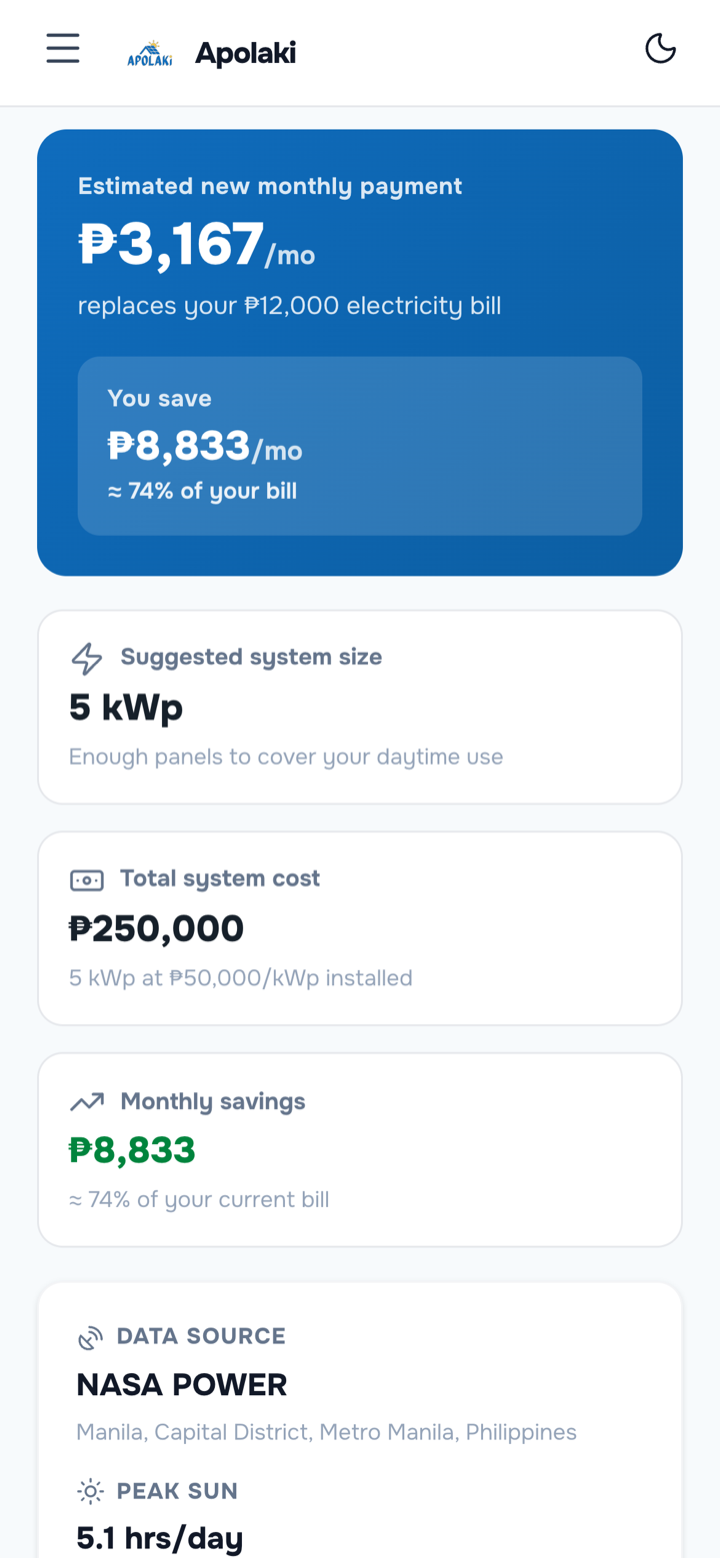
Apolaki solar results screen showing system size, savings and payback
Solar readiness report
System size, savings, payback — instantly
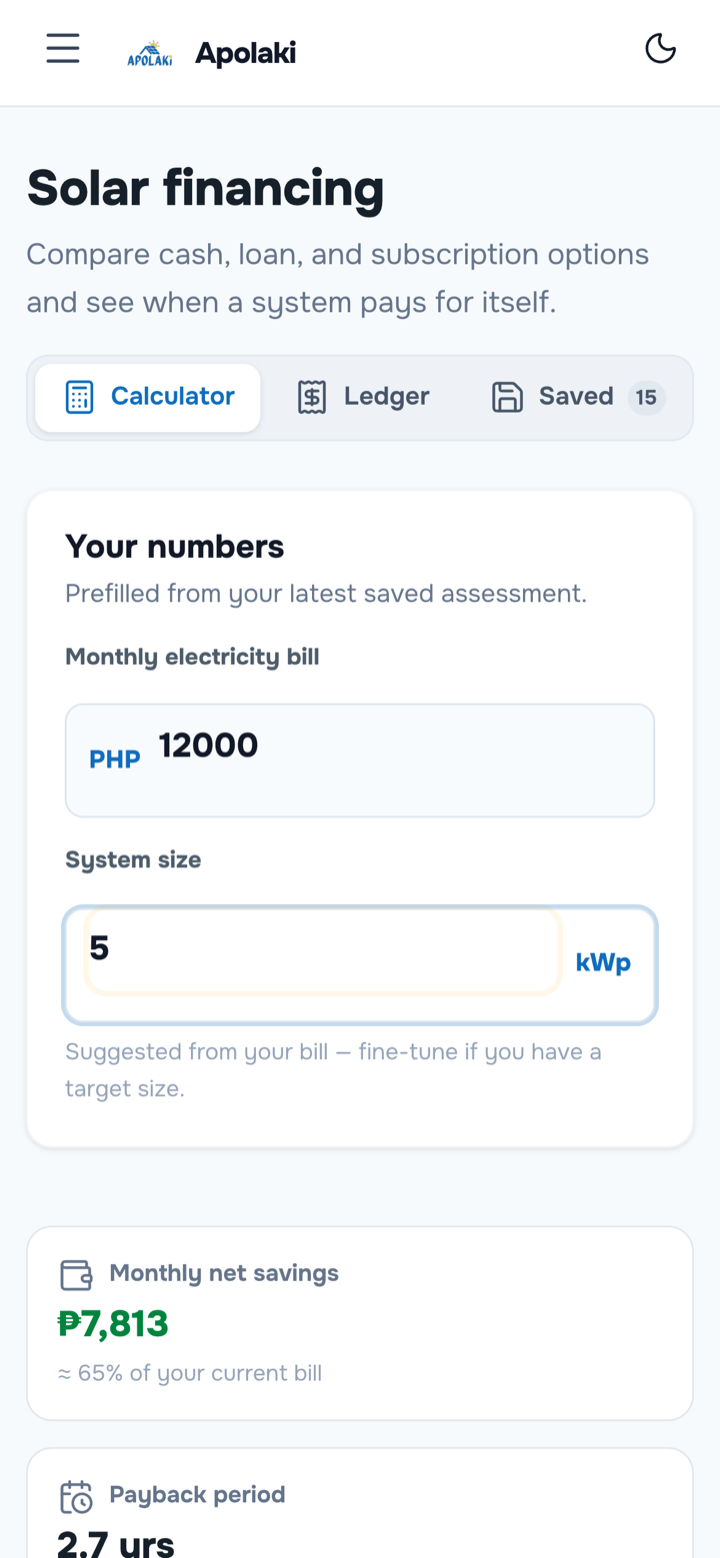
Apolaki financing preview screen
Financing preview
Monthly payment vs. bill savings
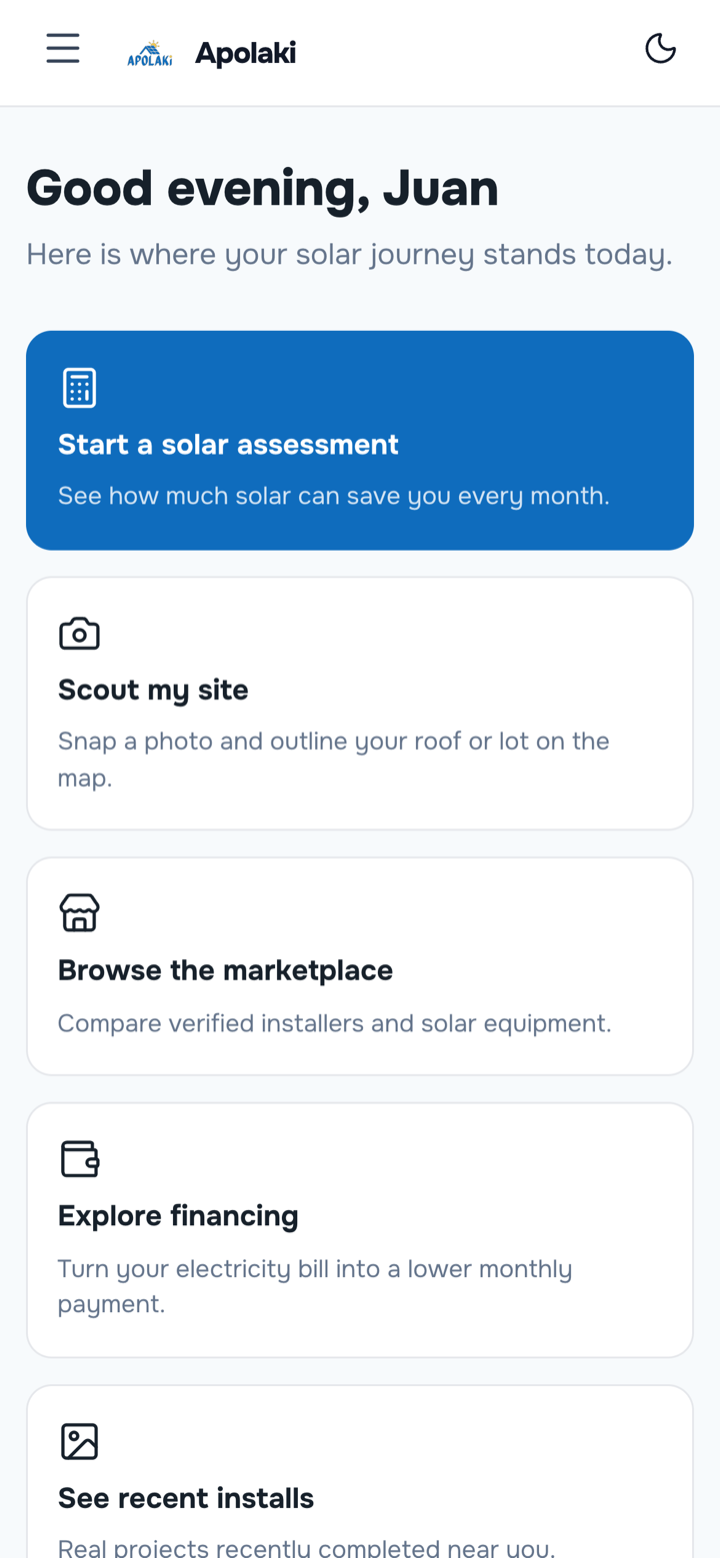
Apolaki monitoring dashboard screen
After-sales monitoring
The relationship that lifts lifetime value
Traction

Early, real, and compounding.

200+
Interested homeowners signed up
2
Installer partners onboarded
5
Installations in the pipeline
Live
Product shipped at apolaki.ai
Partner with us

We're recruiting installers and financiers.

Apolaki is building the trusted rails for residential solar in the Philippines. If you install, finance, or invest in clean energy, there's a seat at this table.

Installers

Qualified, ready-to-buy leads with a full solar profile — lower CAC, less pre-sales grind, one tool to quote, win and manage jobs.

Financiers

A standardised, de-risked solar profile per customer — the technical and financial signal to underwrite faster and reach more borrowers.

Investors

A capital-efficient GTM with a compounding stock engine — every peso of profit reinvested to widen the moat and lower the cost of solar.

Contact us

apolaki.ai · Metro Manila, Philippines